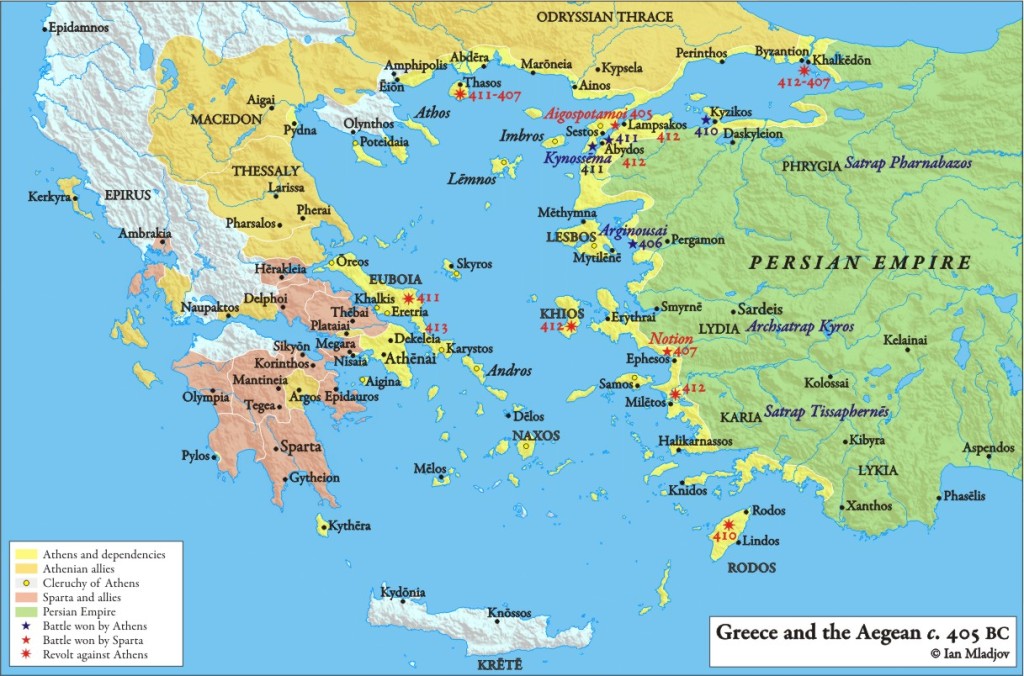
The Aegean Sea during the later Peloponnesian War from Ian Mladjov’s Maps
Darius II’s reign in Anatolia saw the Persian reconquest of Ionia and the Greek cities of west Asia. This was only accomplished with the aid of a surprising ally: Sparta and the Peloponnesian League. Download
The modern ruins of Artaxerxes Hall of 100 Columns via Wikimedia.
At just over 40 years on the throne, Artaxerxes I was the second-longest reigning Achaemenid king. This is an episode for all of the little things and less detailed stories that played out in that time. From a new status quo in the west to dramatic building projects in the east, Artaxerxes was a busy guy. Download
An Assyrian Soldier, like those in Megabyzus’ army, as depicted on Xerxes’ tomb via Wikimedia
The story of the Megabyzid family conveniently flows from a solid recap of the story so far straight into the next major event in Achaemenid history: the very first satrap’s revolt, complete with Greek mercenaries and royal family drama. Download
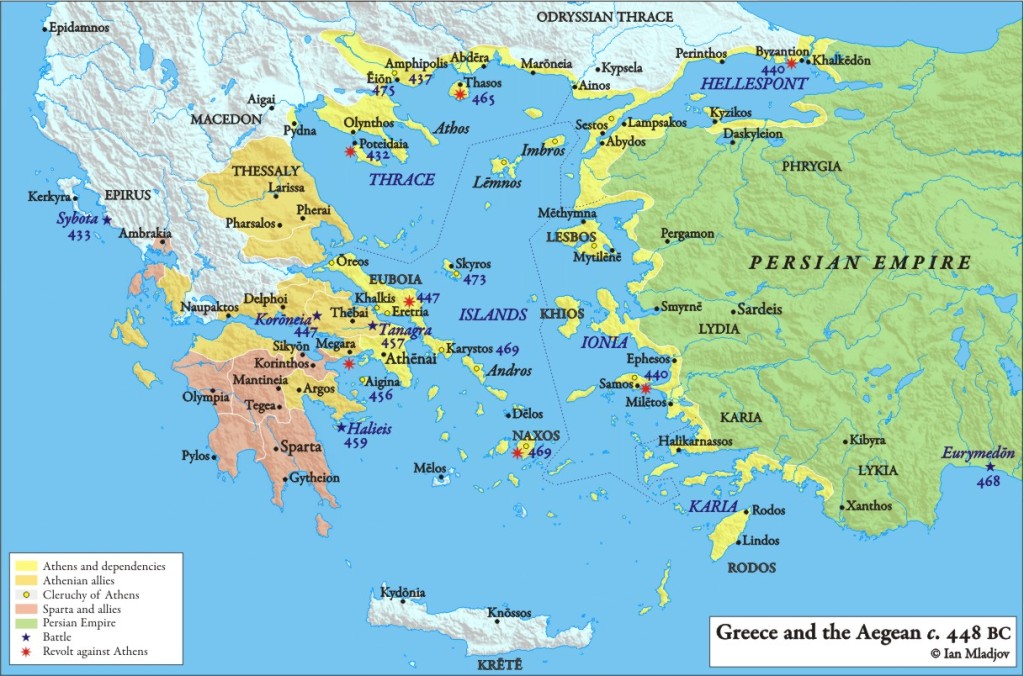
Map of the approximate boundaries of the Persian Empire and Greek leagues in the Aegean after the Peace of Callias via Ian Mladjov.
The treaty known as the Peace of Callias supposedly ended the second Greco-Persian War with a formal agreement between Athens and Persia. However, its very existence is the topic of intense historical debate. Despite this, hostilities did cease in 449 BCE, so something must have happened, right? Download
A cylinder seal depicting the Achaemenid King executing an Egyptian Pharaoh, usually identified with Cambyses, Artaxerxes I, or Artaxerxes III via Wikimedia
The city of Memphis spent almost five years under siege from 459-454 BCE, as the rebel Pharaoh Inaros tried to take the Egyptian capital and oust the Persian government with the aid of the Athenians. When Persian reinforcements arrived, the rebellion was swept aside with apparent ease. Inaros was captured and Athens was sent reeling, only to make one final attempt on Persian territory in Cyprus. Download
Dedication to the Egyptian god Amun-Min by Artaxerxes via WikimediaMap of the Athenian Campaign in Egypt via WikimediaInscription from Artaxerxes in Egypt (L) and Map of the Athenian campaign with Inaros (R)
After Artaxerxes I came to power in 465 BCE, a minor rebellion broke out in western Egypt led by the would-be Pharaoh Inaros II. Inaros quickly came to a stalemate with the local satrap, but in 460 BCE the Egyptian rebel reached out to Athens for aid. The Athenians came in force, broke the stalemate, killed the satrap (and Artaxerxes’ uncle), and joined Inaros as he marched on Memphis. Download
Themistocles standing before Artaxerxes for the first time illustrated by Walter Crane in The story of Greece : told to boys and girls by Mary Mcgregor via Wikimedia
In late 465 BCE, Xerxes I – the King of Kings – was murdered in his sleep by his own captain of the guard, Artabanus the Hyrcanian. Artabanus and a group of highly placed conspirators chose their victim’s third son, Artaxerxes to be their puppet on the throne and moved to secure their coup. Unbeknownst to them, Artaxerxes was not easily manipulated. When the conspirators turned on one another, the Achaemenid Empire plunged headfirst into the age of Artaxerxes with a new round of civil wars. Download
Bust of Kimon in Lanarca, Cyprus via WikimediaThe mouth of the Eurymedon/Köprüçay in 2018 via Google Street View
Most of the decade following the first offensive Greek campaigns against Xerxes’ forces are lost to us. There are hints at great battles and rapid Athenian expansion, but almost nothing is certain until the Battle of the Eurymedon. In the mid-460s BCE, the Persian fleet had recovered enough to stage a renewed offensive, but the Athenian general Kimon had advanced warning. He commanded a fleet from Athens’ Delian League and made a preemptive strike in southern Anatolia, where he destroyed the fleet and routed the Persian army. This battle at the mouth of the Eurymedon River once again changed the direction of Persia’s war with Athens, effectively kicking Persian military power out of the Aegean for decades to come. Download
An Old Persian copy of the Daiva Inscription discovered at Persepolis, via Livius.org
Early in Xerxes’ reign, an infamous and dramatic story of religious conflict was inscribed at Persepolis. When Xerxes became king he put down a rebellion, but in the process encountered a community dedicated to a god or gods he considered false and immoral. As consequence he destroyed their sanctuary and worshiped Ahura Mazda in their place. Download
Xerxes depicted in Guillaume Rouillé’s Promptuarium Iconum Insigniorum, 1553
As the reign of another king draw’s toward a close, it’s time to look at the royal family. Xerxes’ household was like a microcosm of early Achaemenid history. His mother, Atossa, drew a direct connection back to Cyrus, his uncles, cousins, and siblings were woven into the political scene of his reign. Herodotus’ catalog of Persian commander’s is also a catalog of the Great King’s family, and many of them held positions of power as Satraps across the empire. The royal family is also an opportunity to look forward, and introduce the next generation of kings, satraps, generals, and rebels. Download





 HoPful Media


